The Pithy Amateur Astronomer

The adventure and aggregation of a short-winded amateur astronomer.

These images of Venus were taken by the Cassini spacecraft. It's pictures like this from the outer solar system that makes me feel alone. Bonus points if you can tell me what the title of this post references to (there are 2 answers here).


Source: http://www.universetoday.com/100450/stunning-views-of-venus-all-the-way-from-saturn/


Two amazing images from the Cassini spacecraft today: We know how brightly Venus shines in our own night sky; now here’s visual proof it shines brightly even in the skies above Saturn. In one image it shines so brightly that it is even visible looking through Saturn’s rings! But in this absolutely stunning shot, above, Venus appears as a morning star, just off the edge of the planet. From Cassini, you’re looking directly above the edge of Saturn’s G ring to see the white dot, which is Venus. Lower down, Saturn’s E ring makes an appearance, looking blue thanks to the scattering properties of the dust that comprises the ring. (A bright spot near the E ring is a distant star, the Cassini CICLOPS team says.)

This beautiful image was taken on January 4, 2013.

On average, Venus and Saturn are about 1,321,200,000 km (820,955,619 mi or 8.83 astronomical units) apart, so that’s a nice, long distance shot! Venus is brighter in Saturn’s skies than Earth is, however, because Venus is covered in thick sulfuric acid clouds, making it very bright.
And here’s the other great shot, showing Saturn and its rings in true color:


Venus is the white dot, just above and to the right of the image center. Again, its amazing that it shines through the rings.

This view looks toward the unilluminated side of the rings from about 17 degrees below the ring plane, and was taken in visible light (and it is a true-color image) with the Cassini spacecraft wide-angle camera on Nov. 10, 2012.

In an email about these images, Cassini imaging team lead Carolyn Porco said that even though Venus reaches nearly 900 degrees Fahrenheit (500 degrees Celsius) and has a surface pressure 100 times that of Earth’s, Venus is considered a twin of our planet because of their similar sizes, masses, rocky compositions and close orbits.

And so, she pointed out, “Think about Venus the next time you find yourself reveling in the thriving flora, balmy breezes, and temperate climate of a lovely day on Earth, and remember: you could be somewhere else!”

See more about these images at the CICLOPS (Cassini Imaging Central Laboratory for Operations) website.


Source: http://apod.nasa.gov/apod/ap121205.html

Explanation: Why does this galaxy emit such spectacular jets? No one is sure, but it is likely related to an active supermassive black hole at its center. The galaxy at the image center, Hercules A, appears to be a relatively normal elliptical galaxy in visible light. When imaged in radio waves, however, tremendous plasma jets over one million light years long appear. Detailed analyses indicate that the central galaxy, also known as 3C 348, is actually over 1,000 times more massive than our Milky Way Galaxy, and the central black hole is nearly 1,000 times more massive than the black hole at our Milky Way's center. Pictured above is a visible light image obtained by the Earth-orbiting Hubble Space Telescope superposed with a radio image taken by the recently upgraded Very Large Array (VLA) of radio telescopes in New Mexico, USA. The physics that creates the jets remains a topic of research with a likely energy source being infalling matter swirling toward the central black hole.

I am a fan of Neil deGrasse Tyson and his ability to bring the field of astronomy to the masses. He has a radio show/podcast located at http://www.startalkradio.net/ and it is definitely worth a listen to. I have subscribed to it and I am currently listening to older episodes to catch up to the latest episode. So far, they are all a joy to listen to and I am sure all the episodes will be equally as great.

Found this on the interwebs and thought I would re-post it. It's an amazing picture of Europa, Jupiter, and the Great Red Spot. I wonder how Jupiter would appear from Europa. I do not know where I found the image at but if I do or you know, I will be glad to cite it.


Multi-frame mosaic.
Voyager 1, March 3, 1979
Image Number: WEB11413-2010
Credit: NASA; JPL; Kinetikon Pictures
For print or commercial use, please contact: Michael Benso
Thanks to Katia Oh for the cite!

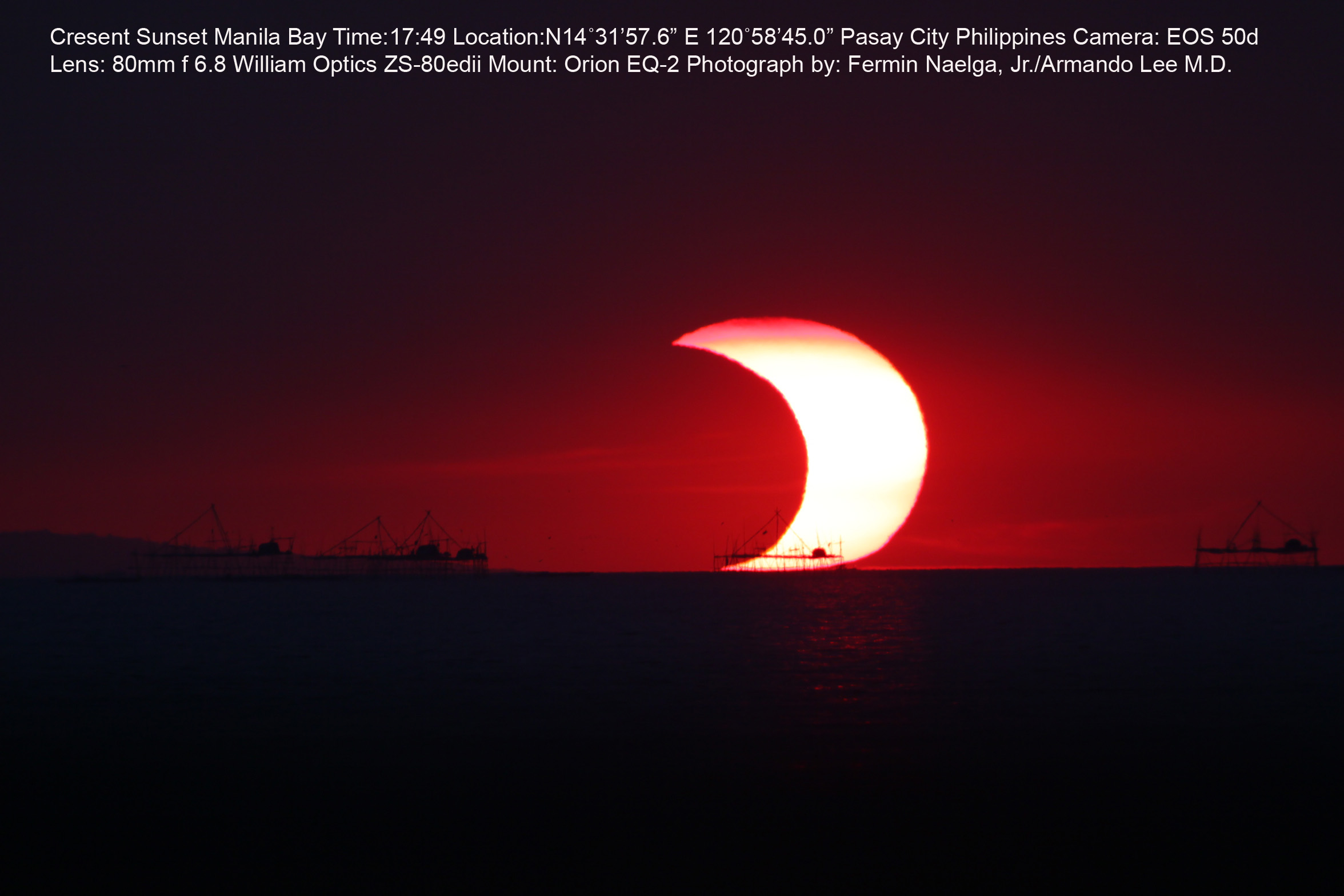
It's not every day that you get to see a crescent Sun. This was caused by the partial eclipse that happened a few days ago.


Source: http://apod.nasa.gov/apod/ap120522.html

This is a good picture of an eclipse. These types of pictures make me realize how big the moon is but the Sun is even bigger.


Source: http://apod.nasa.gov/apod/ap120520.html

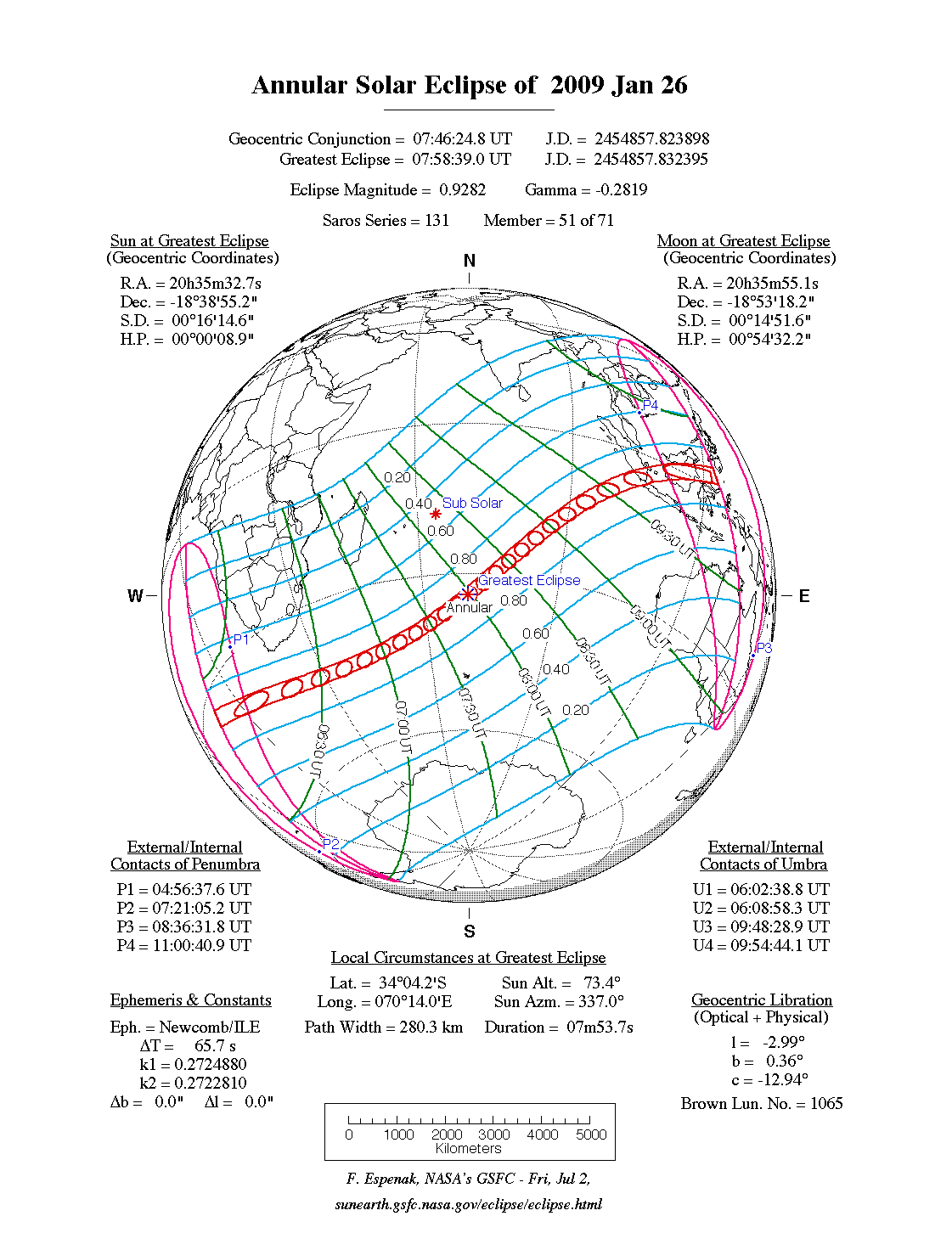
Explanation: What's happened to the setting Sun? An eclipse! In early 2009, the Moon eclipsed part of the Sun as visible from parts of Africa, Australia, and Asia. In particular the above image, taken from the Mall of Asia seawall, caught a partially eclipsed Sun setting over Manila Bay in the Philippines. Piers are visible in silhouette in the foreground. Eclipse chasers and well placed sky enthusiasts captured many other interesting and artistic images of the year's only annular solar eclipse, including movies, eclipse shadow arrays, and rings of fire. Today parts of the Sun again will become briefly blocked by the Moon, again visible to some as a partial eclipse of a setting Sun. A small swath of Earth, however, will be exposed to the unusual ring of fire effect when the Moon is completely surrounded by the glowing light of the slightly larger Sun.

Russian Satellite Elektro-L took this picture of Earth. The detail is stunning and the color looks like an artist added it (even though it wasn't). Below is the post from Universe Today where I found the picture.


Unlike most satellite images of Earth, this one was not assembled from multiple swath scans or digitally projected onto a globe model — it’s the full disk of our planet in captured as a single, enormous 121 megapixel image, acquired by Russia’s Elektro-L weather-forecasting satellite.


Like NASA’s GOES satellites, Elektro-L is parked in a geostationary orbit approximately 36,000 km (22,300 miles) above our planet. Unlike NASA’s satellites, however, Elektro-L captures images in near-infrared as well as visible wavelengths, providing detail about not only cloud movement but also vegetation variations. Its wide-angle Multichannel Scanning Unit (MSU) takes images every 15-30 minutes, showing the same viewpoint of Earth across progressive times of the day.


At a resolution of 0.62 miles per pixel, full-size Elektro-L images are some of the most detailed images of Earth acquired by a weather satellite.


A second Elektro-L satellite is anticipated to launch in 2013.Launched aboard a Zenit rocket on January 20, 2011, Elektro-L was the first major spacecraft to be developed in post-Soviet Russia. Parked over Earth at 76 degrees east longitude, Elektro-L provides local and global weather forecasting and analysis of ocean conditions, as well as “space weather” monitoring — measurements of solar radiation and how it interacts with Earth’s magnetic field. Its initial lifespan is projected to be ten years.


Source: http://www.universetoday.com/95108/from-russia-with-love-a-singularly-stunning-image-of-earth/


For those of who may not know, Venus will transit the Sun this year. The event will happen on June 5 and 6, 2012. I suggest you get a welding mask or a proper filter for your telescope, binoculars, camera, or other viewing apparatuses. 

There is an app for your phone but I am not sure what exactly it does. Visit http://transitofvenus.nl/wp/getting-involved/phone-app/ for more information on the app.

When some people look at clouds, they interpret the shapes and make comparisons to other objects. I do the same but instead of clouds I look at astronomical bodies.


Source: http://apod.nasa.gov/apod/ap110922.html


Source: http://en.wikipedia.org/wiki/The_Scream


Explanation: Linking spiral arms, two large colliding galaxies are featured in this remarkable cosmic portrait constructed using image data from the Hubble Legacy Archive. Recorded in astronomer Halton Arp's Atlas of Peculiar Galaxies as Arp 272, the pair is otherwise known as NGC 6050 near center, and IC 1179 at upper right. A third galaxy, likely also a member of the interacting system, can be spotted above and left of larger spiral NGC 6050. They lie some 450 million light-years away in the Hercules Galaxy Cluster. At that estimated distance, the picture spans over 150 thousand light-years. Although this scenario does look peculiar, galaxy collisions and their eventual mergers are now understood to be common, with Arp 272 representing a stage in this inevitable process. In fact, the nearby large spiral Andromeda Galaxy is known to be approaching our own galaxy and Arp 272 may offer a glimpse of the far future collision between Andromeda and the Milky Way.


This image reminds me of some serious confetti.

Abell 2744: Pandora's Cluster of Galaxies 
Image Credit: NASA, ESA, J. Merten (ITA, AOB), & D. Coe (STScI)

Explanation: Why is this cluster of galaxies so jumbled? Far from a smooth distribution, Abell 2744 not only has knots of galaxies, but the X-ray emitting hot gas (colored red) in the cluster appears distributed differently than the dark matter. The dark matter, taking up over 75 percent of the cluster mass and colored blue in the above image, was inferred by that needed to create the distortion of background galaxies by gravitational lensing. The jumble appears to result from the slow motion collision of at least four smaller galaxy clusters over the past few billion years. The above picture combinesoptical images from the Hubble Space Telescope and the Very Large Telescope with X-ray images from the Chandra X-Ray Observatory. Abell 2744, dubbed Pandora's cluster, spans over two million light years and can best be seen with a really large telescope toward the constellation of the Sculptor.

The space shuttle appears to break through the clouds in what would be the ultimate adrenalin rush for me.

Source: http://apod.nasa.gov/apod/ap110525.html
Credit: NASA


Explanation: What's that rising from the clouds? The space shuttle. If you looked out the window of an airplane at just the right place and time last week, you could have seen something very unusual -- the space shuttle Endeavour launching to orbit. Images of the rising shuttle and its plume became widely circulated over the web shortly after Endeavour's final launch. The above image was taken from a shuttle training aircraft and is not copyrighted. Taken well above the clouds, the image can be matched with similar images of the same shuttle plume taken below the clouds. Hot glowing gasses expelled by the engines are visible near the rising shuttle, as well as a long smoke plume. A shadow of the plume appears on the cloud deck, indicating the direction of the Sun. The shuttle Endeavour remains docked with the International Space Station and is currently scheduled to return to Earth next week.

Found this on the interwebs and thought I would re-post it. It's an amazing picture of Europa, Jupiter, and the Great Red Spot. I wonder how Jupiter would appear from Europa...

Mark your calendars for November 8, 2011, because:

The near-Earth asteroid named 2005 YU55 — on the list of potentially dangerous asteroids — was observed with the Arecibo Telescope's planetary radar on April 19, 2010 when it was about 1.5 million miles from the Earth, which is about 6 times the distance to the moon.


Source: http://www.space.com/11310-huge-asteroid-2005-yu55-passing-earth-november.html


Source: http://apod.nasa.gov/apod/ap110403.html

Image Credit: Sydney Girls High School Astronomy Club,
Travis Rector (Univ. Alaska), Ángel López-Sánchez (Australian Astronomical Obs./ Macquarie Univ.), Australian Gemini Office
 
Explanation: Over 400,000 light years across NGC 6872 is an enormous spiral galaxy, at least 4 times the size of our own, very large, Milky Way. About 200 million light-years distant, toward the southern constellation Pavo, the Peacock, the remarkable galaxy's stretched out shape is due to its ongoing gravitational interaction, likely leading to an eventual merger, with the nearby smaller galaxy IC 4970. IC 4970 is seen just below and right of the giant galaxy's core in this cosmic color portrait from the 8 meter Gemini South telescope in Chile. The idea to image this titanic galaxy collision comes from a winning contest essay submitted last year to the Gemini Observatory by the Sydney Girls High School Astronomy Club. In addition to inspirational aspects and aesthetics, club members argued that a color image would be more than just a pretty picture. In their winning essay they noted that "If enough colour data is obtained in the image it may reveal easily accessible information about the different populations of stars, star formation, relative rate of star formation due to the interaction, and the extent of dust and gas present in these galaxies". (Editor's note: For Australian schools, 2011 contest information is here.)


Source: http://apod.nasa.gov/apod/ap110329.html

Illustration Credit: Jason Rowe, Kepler Mission
Explanation: Using the prolific planet hunting Kepler spacecraft, astronomers have discovered 1,235 candidate planets orbiting other suns since the Kepler mission's search for Earth-like worlds began in 2009. To find them, Kepler monitors a rich star field to identify planetary transits by the slight dimming of starlight caused by a planet crossing the face of its parent star. In this remarkable illustration, all of Kepler's planet candidates are shown in transit with their parent stars ordered by size from top left to bottom right. Simulated stellar disks and the silhouettes of transiting planets are all shown at the same relative scale, with saturated star colors. Of course, some stars show more than one planet in transit, but you may have to examine the picture at high resolution to spot them all. For reference, the Sun is shown at the same scale, by itself below the top row on the right. In silhouette against the Sun's disk, both Jupiter and Earth are in transit.


Source: http://apod.nasa.gov/apod/ap110326.html

Image Credit & Copyright: Adam Block, Mt. Lemmon SkyCenter, U. Arizona
Explanation: The yellowish star near center in this remarkable telescopic skyview is T Tauri, prototype of the class of T Tauri variable stars. Nearby it is a dusty yellow cosmic cloud historically known as Hind's Variable Nebula (NGC 1555). Over 400 light-years away, at the edge of a molecular cloud, both star and nebula are seen to vary significantly in brightness but not necessarily at the same time, adding to the mystery of the intriguing region. T Tauri stars are now generally recognized as young (less than a few million years old), sun-like stars still in the early stages of formation. To further complicate the picture, infrared observations indicate that T Tauri itself is part of a multiple system and suggest that the associated Hind's Nebula may also contain a very young stellar object. The naturally colored image spans about 4 light-years at the estimated distance of T Tauri.


Source: http://apod.nasa.gov/apod/ap110323.html

Credit & Copyright: Peter Tuthill (Sydney U.) & James Lloyd (Cornell)


Explanation: What could cause a nebula to appear square? No one is quite sure. The hot star system known as MWC 922, however, appears to be embedded in a nebula with just such a shape. The above image combines infrared exposures from the Hale Telescope on Mt. Palomar in California, and the Keck-2 Telescope on Mauna Kea in Hawaii. A leading progenitor hypothesis for the square nebula is that the central star or stars somehow expelled cones of gas during a late developmental stage. For MWC 922, these cones happen to incorporate nearly right angles and be visible from the sides. Supporting evidence for the cone hypothesis includes radial spokes in the image that might run along the cone walls. Researchers speculate that the cones viewed from another angle would appear similar to the gigantic rings of supernova 1987A, possibly indicating that a star in MWC 922 might one day itself explode in a similar supernova.

Watch how NASA recovers the Solid Rocket Boosters. I never realized how big the SRB's were until I saw this video. It really puts things into perspective.

Source: http://www.space.com/11068-shuttle-discovery-astronauts-tribute.html


On the eve of space shuttle Discovery's final scheduled trip back to Earth, the six astronauts aboard the spaceship paid tribute to their tried and true orbiter.

"I think the legacy that this shuttle has made for herself is just nothing short than cause for celebration," said mission specialist Michael Barratt during a call with reporters today (March 8). "Just something that our country should be very, very proud of."


Discovery is finishing up its 39th and final voyage, a two-week mission to deliver supplies and a robotic astronaut helper to the International Space Station. [Photos from Discovery's Final Mission]

After this STS-133 mission, only two more space shuttle flights remain, and then NASA is retiring the fleet. Shuttle Endeavour is slated to launch on its STS-134 voyage in April, and Atlantis is scheduled to blast off one last time on the STS-135 mission in June.

Over the course of 39 missions, Discovery has launched probes and satellites, deployed the Hubble Space Telescope, and then visited to repair it. The shuttle has also contributed significantly to the construction and operation of the International Space Station.

"The legacy for the shuttle fleet and the shuttle program undoubtedly, in my mind, will be the space station," LeRoy Cain, NASA's mission management team chairman, told the media today. "We could not have assembled this marvelous facility in orbit without the capabilities of the space shuttle."
After the shuttles retire, they will be sent to U.S. museums for public display.

"I don’t know what the plaque is going to say, but hopefully it will talk about Discovery's legacy as a great ship of exploration, as a class of spacecraft with capabilities … unmatched by anything else we've ever seen in space and probably unmatched for a long, long time to come," said Discovery's commander, Steve Lindsey."Hopefully it will talk about not the crews, not us, but the entire space shuttle teams that span across the country that have allowed this to happen – the thousands and thousands and thousands of people to keep this vehicle running. Hopefully the legacy will be more about the people than anything else."

Discovery and the other shuttles are being retired after 30 years of service to make way for NASA's next step, a push to travel beyond low-Earth orbit to an asteroid and Mars. The space shuttles, while still functioning well, are simply considered too expensive to operate while NASA is also trying to develop and build its next-generation spaceship.[Gallery: Building Space Shuttle Discovery]

"There is not a single thing wrong with her," Lindsey said of Discovery, the oldest of the shuttles."Every single system and every piece of every system is working just like it's brand new."

Once it retires the shuttles, NASA will have to rely on Russian Soyuz spaceships to get to the International Space Station until American commercial companies start producing vehicles capable of doing the job. No spaceship under development will be able to carry so many crew members and so much cargo to the station as the massive shuttles have.

"It's going to be sad when it's over, when we land tomorrow or the next day," Lindsey said."The hardest part of this for me is giving up the capability. It can do everything except leave low-Earth orbit."
Yet he said it was the right thing to do.

"It's sad to give up this type of capability, but I really strongly believe in the next step to try to get out of low-Earth orbit, to try to go to an asteroid, go to the moon," Lindsey said. "We do need a new vehicle for that."

Other astronauts expressed similar sentiments.

"There are plenty of opportunities out there, and we're a great country that has done really, really amazing things with our space program and I really just hope that that will continue," mission specialist Nicole Stott said.

Discovery is scheduled to land tomorrow at NASA's Kennedy Space Center in Cape Canaveral, Fla., at 11:57 a.m. EST (1657 GMT).

Amazing video. Worth the time to watch.


5.6k Saturn Cassini Photographic Animation from stephen v2 on Vimeo.

Followers

Moon Phase